
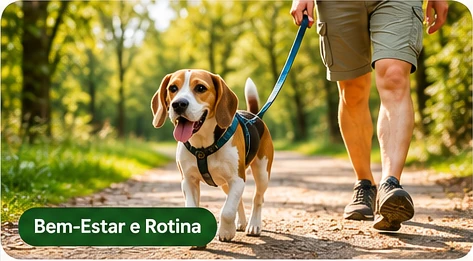
Make each walk a chance to explore, feel safe and connect at your dog’s pace.
A good dog walk is more than exercise
Walks provide more than physical activity and toilet breaks. They give dogs a chance to explore through scent, gather information and share time with their humans. A short, relaxed sniffing walk may offer more than a longer outing rushed from start to finish.
There is no universal ideal distance. Age, health, temperature, fitness, confidence and individual needs should guide the plan. Older dogs and dogs recovering from illness may need a very different routine from healthy young dogs.
Habit 1 — Choose the right route
Notice where your dog seems comfortable. Quiet streets and predictable routes can make learning easier. If a dog struggles around traffic, bicycles or other dogs, increase the distance rather than forcing close encounters.
Introduce new locations gradually. A walk does not have to be challenging every day; familiar and manageable experiences are valuable too.
Habit 2 — Check the lead, harness and safety
Choose a well-fitting harness that allows comfortable movement. Check straps, clips, identification and lead length. Avoid equipment that causes pain or unnecessary neck pressure. In busy areas, keep a safe distance from roads and unexpected hazards.
Consider the ground temperature, weather, water needs and the local rules for dogs in public places before setting off.
Habit 3 — Practise loose-lead walking
Start somewhere quiet. Mark and reward moments when the lead hangs loosely. If the dog pulls, stop calmly before tension increases. When they turn towards you or return to a comfortable distance, reward and walk again. Avoid sharp lead corrections.
The RSPCA recommends this reward-based approach to loose-lead walking. Practise consistently and add distractions gradually.
Habit 4 — Make time for sniffing
Sniffing is an important way dogs investigate their surroundings. Whenever safe, let your dog explore grass, trees and interesting smells. You can alternate between walking along and giving a simple cue that means it is time to sniff.
The Blue Cross identifies slow sniffing walks as a form of enrichment, especially for dogs who remain on the lead.
Habit 5 — Notice signs of discomfort
A stiff body, attempts to move away, freezing, a lowered tail or intense scanning may suggest that the dog is uncomfortable. Look at the whole situation rather than diagnosing from one signal.
Create distance from triggers, slow down or change direction. Do not require your dog to greet every person or animal. A successful walk is one where the dog feels reasonably safe and can recover from surprises.
Habit 6 — Adapt to weather and health
During hot weather, avoid the warmest hours and check the surface temperature. Carry water where needed and look for shade. In rain or cold conditions, adapt the duration to the individual dog. Veterinary guidance is particularly important for dogs with breathing, joint or heart conditions.
If the dog limps, refuses to continue, pants unusually or appears exhausted, end the activity and seek veterinary advice when appropriate.
Habit 7 — End with a calm routine
Slow the pace towards the end of the walk and offer a final opportunity to sniff. Once home, provide water and a comfortable resting place. Predictable routines may be especially helpful for dogs who become highly excited before and after outings.
Rather than counting kilometres alone, ask whether the dog explored safely, coped with the environment and recovered after unexpected events.
Frequently asked questions
Should I let my dog sniff?
Yes, when the location is safe. Sniffing is a natural and valuable part of exploring.
What if my dog pulls hard?
Practise loose-lead walking in easy locations, reward slack-lead moments and increase distractions in small steps.
Are longer walks always better?
No. Safety, suitable activity and quality of exploration matter more than distance alone.
References and further reading
Editorial note: General educational information, not a substitute for veterinary advice or individual behaviour assessment.