
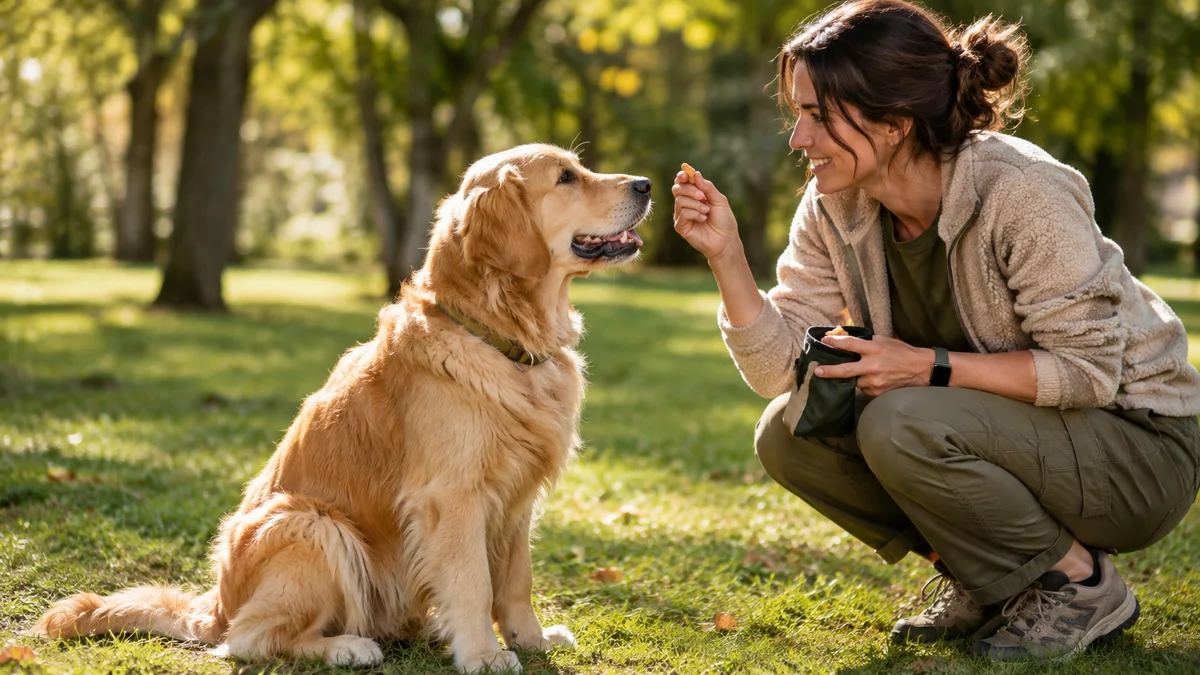
Hitting, shouting or jerking a lead may stop a dog momentarily, but stopping is not the same as learning. Explore the science and practical ways to teach without fear.
What does positive dog training actually mean?
Reward-based training primarily teaches behaviours by reinforcing a response a dog offers: sitting, returning when called or walking on a loose lead. Reinforcement may be food, play, praise, access to sniffing or another consequence the particular dog finds valuable.
It also includes planning the environment, setting clear boundaries, preventing rehearsals of unwanted behaviour and breaking skills into small achievable steps. It is neither endless treats nor a refusal to manage safety.
In learning theory, positive reinforcement means adding a desirable consequence to increase behaviour. Positive punishment means adding something unpleasant to reduce behaviour. Positive and negative describe adding or removing a stimulus; they do not mean good and bad.
Why hitting or punishing is not the answer
Punishment may stop a response briefly without teaching what should happen next. A dog who stops barking after a painful lead correction may still be afraid. Silence does not demonstrate emotional comfort.
Hitting, shouting and forceful physical corrections may increase stress and fear and damage trust. Results vary across dogs and contexts, but these risks are avoidable. Effective training identifies the reason for a behaviour, improves the situation and teaches a safer alternative.
If an immediate danger arises, such as a dog about to run into traffic, preventing injury comes first. That practical need does not justify using physical punishment as an everyday training strategy.
What scientific research and veterinary specialists say
A 2020 PLOS ONE study by Vieira de Castro and colleagues examined companion dogs trained at schools using different methods. Dogs exposed to aversive-based training showed more stress-related behaviours and physiological stress indicators than dogs in reward-oriented programmes. This is observational evidence rather than proof that every dog responds identically.
The American Veterinary Society of Animal Behavior (AVSAB) recommends reward-based methods for dog training and behaviour modification. Its 2025 board statement reaffirmed its 2021 position against aversive methods and equipment designed to cause discomfort.
The evidence does not imply that treats alone resolve serious fear, aggression or separation problems. Individual assessment, veterinary input and professional behavioural support may be necessary.
Seven myths and facts
Myth 1 — Without punishment a dog has no boundaries. Clear routines, safe management and consistent rewards establish boundaries without force.
Myth 2 — You must be the alpha. Physical dominance is not a useful universal explanation for learning or relationships. Predictability, communication and safety are more productive.
Myth 3 — Treats are bribes. Reinforcement delivered after a response helps learning. Constantly showing a treat before a request can become an unhelpful cue; gradually vary reinforcement once a skill is learned.
Myth 4 — A guilty-looking dog knows it did wrong. Cowering, looking away or lowering the head may be responses to the owner’s tone and body language; they are not proof of moral understanding.
Myth 5 — A correction is the only way to stop unwanted behaviour. Timing matters, but preventing an error and teaching an alternative are more informative.
Myth 6 — Reward-based training only works for puppies. Adult and older dogs can learn too, although health, history and experience shape the pace.
Myth 7 — Positive training means ignoring dangerous behaviour. Barriers, appropriate leads, distance and supervision protect people and dogs while safer responses are taught.
Five practical examples
1. Jumping at visitors. Prepare greetings at a manageable distance. Reward four paws on the floor and simple skills the dog already knows.
2. Pulling on the lead. Practise in a quiet place, reward loose-lead walking and increase distractions gradually. Avoid painful jerks.
3. Barking at the doorbell. Start with a quiet recording of the sound, reinforce calm attention and teach the dog to go to a mat. Reduce intensity if they become frightened.
4. Chewing shoes. Remove tempting objects, provide safe chew options and reinforce their use. Scolding after you discover damage cannot explain the alternative.
5. Ignoring recall. Practise indoors, use one consistent cue, reward generously and build up in secure areas. Never call a dog over to punish them.
A simple ten-minute training plan
Choose one observable goal rather than a vague ambition. “Sit when asked” can be counted; “be good” cannot. Start where your dog can succeed.
Use several brief blocks of a few minutes, with breaks in between. Work on duration, distance or distraction separately, increasing only one at a time. Avoid training when your dog is exhausted, frightened or in pain.
Keep a simple record of successful responses, useful reinforcers and situations where concentration faded. Ten minutes is merely an example, not a universal requirement.
Common mistakes and how to avoid them
Repeating cues too many times, expecting a skill in a busy street before practising at home and rewarding late can all confuse learning. Food is not the only useful reward: sniffing, play and access to an activity can be powerful too.
Another mistake is training when the dog is already overwhelmed by fear or reactivity. Adjust intensity and distance until they can cope. Worsening behaviour means it is time to reassess rather than increase pressure.
Avoid assuming breed or age tells the whole story. Health, rest, individual temperament and previous experiences matter. Aim for measurable progress rather than perfection.
When professional support is needed
Speak with a veterinarian about sudden aggression, pain, unexplained behaviour changes, dangerous bites, severe fear or distress when left alone. Medical contributors and safety should be considered before a behaviour plan is designed.
Ask a prospective trainer exactly which techniques they use, how they handle fear and whether they will refer to a vet when needed. Avoid trainers who depend on pain, intimidation or guarantees of instant results.
You can also explore our introductory guide to reward-based training, calmer walks and separation anxiety guide.
Frequently asked questions
Can you train a dog without punishment? Yes. Rules can be taught with predictable routines, management and reinforcement. Safety always matters.
Will my dog only respond for food? Once a skill is reliable, vary reinforcement and use naturally rewarding activities.
Can a sharp lead correction work? It may interrupt behaviour briefly, but carries physical and emotional risks and does not necessarily teach an alternative.
How long does learning take? It depends on the dog, goal and setting. Track small improvements and adapt rather than expecting a guaranteed timetable.
Sources and scientific evidence
- AVSAB — Humane Dog Training Position Statement (2021)
- AVSAB — Position statements and 2025 clarification
- Vieira de Castro et al. (2020), PLOS ONE
Educational information; not a substitute for an individual veterinary or behaviour assessment. Scientific sources checked in November 2026.