
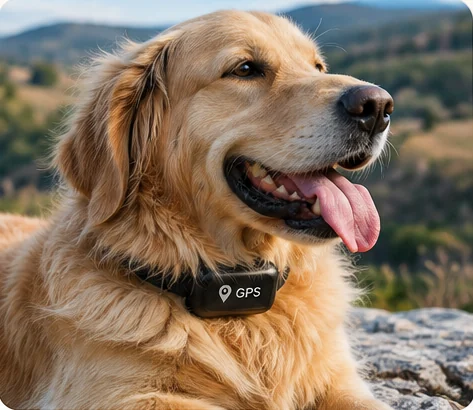
A GPS dog tracker can be useful if a dog wanders away, but it is not a safety guarantee. Before buying, understand how the device finds its position, how that position reaches your phone, local coverage and the ongoing cost.
What a tracker can do
A tracker can help locate an animal within the limits of satellite coverage, mobile signal, device battery and service availability. It is not a guarantee of real-time location in every setting.
A tracker can show the most recently reported position of a device attached to a dog. It is not a guarantee of recovery: signals can fail indoors, in remote areas or around obstacles. Some products combine satellite positioning with mobile networks, while others depend on Bluetooth or nearby compatible devices.
Before comparing brands, define what you need. Do you want to monitor urban walks, receive escape alerts or locate a dog that has left a known area? Check that the features work in Portugal, how often the position updates and how the app communicates signal loss. The phrase 'real time' does not always mean an instant update.
Size and weight matter: a bulky tracker can be uncomfortable for a small dog. Check the attachment method, the manufacturer's stated water resistance and battery performance in the conditions in which you expect to use it.
The cost beyond the device
Compare subscription fees, battery life, weight, coverage and the quality of the app. Consider the annual cost rather than only the purchase price.
The purchase price is only one cost. Some trackers need monthly or annual subscriptions; others rely on third-party services. Calculate the total cost over one or two years, including the device, charging, replacement attachments and data plans where relevant.
Look closely at battery claims. Frequent position updates, weak network coverage and extreme temperatures can reduce actual runtime. If you need the device during travel or long outdoor activities, plan charging rather than assuming it will always be available.
Review app permissions, location sharing and privacy information. Trackers can collect movements and potentially reveal household routines. Favour providers that explain how data is used and make it easy to manage access and notifications.
No substitute for identification and supervision
Keep legal identification and contact details up to date. A tracker complements, but does not replace, safe handling, training and responsible supervision.
Technology does not replace identification, escape prevention or supervision. Keep the dog's registration details current, check locks and fences, and teach useful skills such as coming when called through appropriate training. A device with no battery or network cannot solve an emergency.
If you use a tracker, test it in a secure environment first. Check map delays, notification delivery and how to see the last known location. Never test by letting a dog loose in an unsafe area; use controlled, supervised conditions.
A tracker can be worthwhile when it addresses a specific need and recurring costs are affordable. For many owners, the first priorities are safer surroundings, correct identification and reliable walking routines. Treat technology as an extra layer of support rather than a replacement for day-to-day care.
GPS, mobile networks and Bluetooth are not the same
A conventional GPS tracker calculates its position using satellite signals. It usually needs another way to send that position to the phone app, commonly a mobile data connection. Consequently, satellite reception alone does not guarantee that the app will receive updates. If cellular coverage is unavailable, the map may show the last known position rather than a current one.
Bluetooth item tags work differently. They usually have a short local range and, in some ecosystems, use nearby compatible phones to relay updates. That may be useful for belongings, but it is not the same service as a long-range tracker developed for pets. Radio-based systems with dedicated receivers also exist, and their usefulness depends on terrain, equipment and range.
No technology guarantees an exact uninterrupted map position. Buildings, dense trees, valleys, obstacles and operating conditions can all affect accuracy and update speed. When a company advertises “real-time” tracking, ask about actual reporting intervals, likely delays and what appears in the app when the network is unavailable.
Eight criteria worth checking before purchase
Start with network coverage where the dog actually lives and walks, not with the headline price. Check supported networks and frequency bands; coverage on your smartphone may differ from that of the tracker. If you travel, ask whether the service works in the destination and whether roaming limits or extra charges apply.
Compare typical battery life and active-tracking battery life, charging time, weight, size, water resistance, attachment security, safe-zone alerts, route history, app compatibility and customer support. Some features process detailed location histories. Read the privacy policy and consider whether you need continuous history storage at all.
Check whether the app clearly shows the time of the last location update. A map pin without a timestamp can create false reassurance. If possible, test the device on familiar walking routes, check notification delivery on your phone and learn how to activate any intensive search mode.
Calculate the total cost over three years
Compare the purchase price plus monthly or annual subscription fees, mounting accessories, possible battery replacement and delivery. A purely illustrative example: a 65 € tracker with a 6 € monthly plan costs 281 € over 36 months before extras; a 120 € tracker with a 3 € plan costs 228 € over the same period. The lowest purchase price may not mean the lowest total cost.
If an annual subscription is offered, confirm minimum commitment, automatic renewal, cancellation and refunds. A promotional first year may not reflect renewal pricing. Check app support, compatibility with your current phone and the availability of customer service. Prices and services can change, so review the latest terms before ordering.
You can add an estimated monthly technology cost to our dog budget calculator to see its place in your wider pet-care spending.
Tracking does not replace prevention
A device may fall off, run out of battery or enter an area with no network. Prevention still matters: secure harnesses and leads, reliable gates and fences, gradual recall training, identification and up-to-date contact details. In Portugal, dogs must be microchipped and registered in the SIAC system as explained by the DGAV. A tracker is a supplement, never a replacement.
Charge the device before unfamiliar routes and check the attachment and last connection. Make sure responsible family members understand what to do if the dog goes missing. If a dog disappears, take appropriate local search steps and contact the relevant authorities; do not rely solely on the app map.
For a technical explanation of mobile coverage, read the manufacturer’s network guide. For identification rules in Portugal, see the DGAV.
A note on individual care
This guide helps organise everyday decisions. Needs vary with each dog’s age, health and behaviour.
Transparency: editorial information. It does not replace veterinary assessment or individual behavioural advice.