
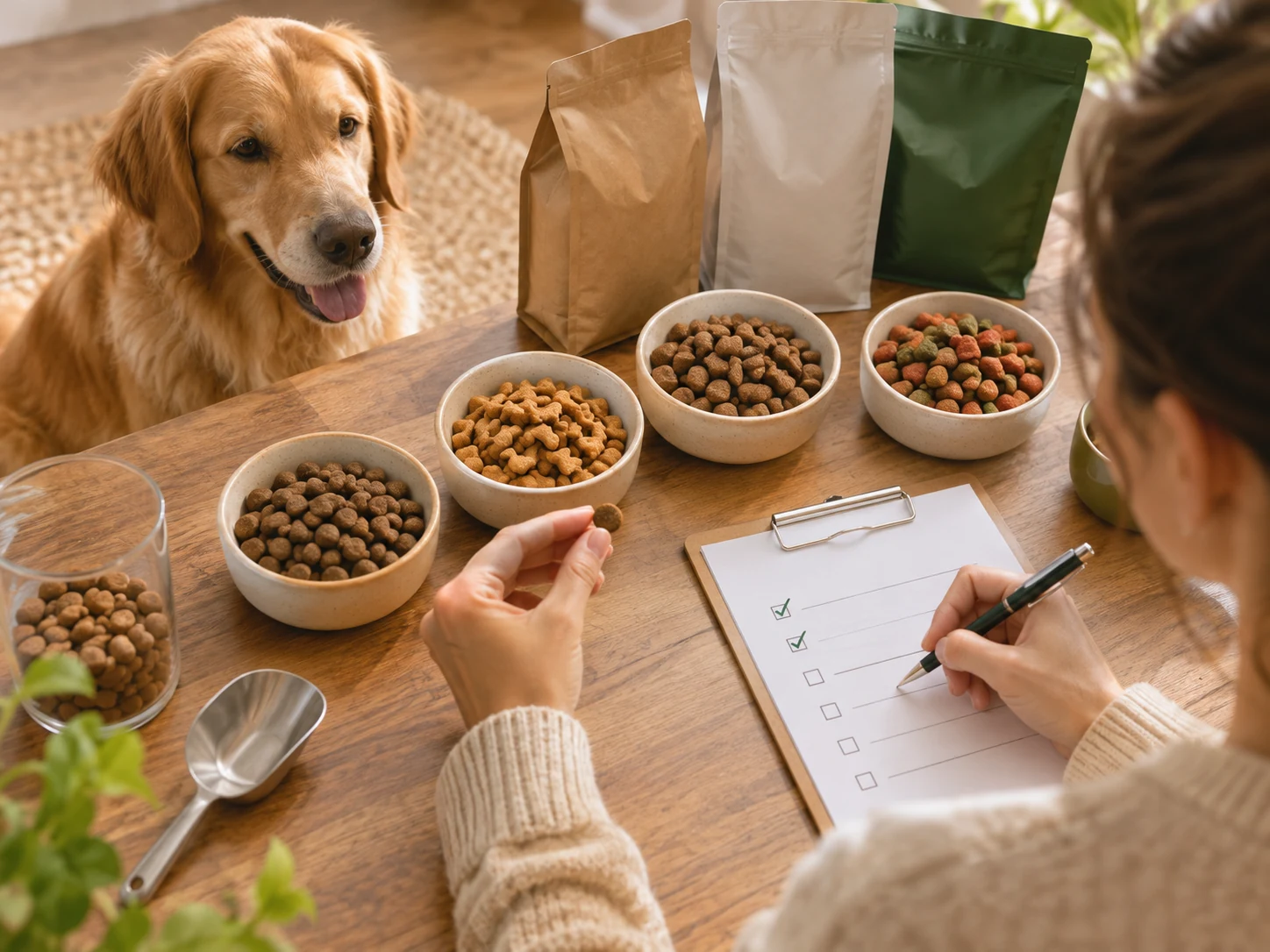
Comparing dog foods involves more than choosing the most attractive bag, counting ingredients or selecting the product with the highest protein percentage. Products differ in their calorie density, moisture content, nutritional purpose and feeding instructions. Unless we compare these dimensions consistently, we can reach the wrong conclusions and choose a food that does not meet the needs of an individual dog.
This guide explains five common mistakes when comparing dog foods and introduces a practical method for avoiding them. It does not attempt to rank every brand. Instead, it shows how to evaluate specific products and relate the available evidence to a dog's age, medical history, activity and body condition.
Mistake 1. Judging food solely by its first ingredient
The ingredient list is important, but it cannot describe the full nutritional quality of a finished product. Ingredients generally appear in descending order of weight at the time they are added to the recipe. This means that fresh meat, dried animal ingredients and other materials with different water contents may appear in positions that do not reflect their final contributions to the nutrients in the food.
Another common assumption is that a list with more familiar-sounding names must be better. An ingredient name alone says nothing conclusive about digestibility, essential amino acid supply, manufacturing checks or the suitability of the complete formula. WSAVA advises owners and veterinary teams to look beyond the opening ingredients and assess nutritional adequacy more thoroughly.
A better approach: start by confirming that the product is complete food for the intended species and life stage. Then examine composition, analytical constituents, feeding instructions and manufacturer information. Ask how the recipe is formulated and checked. Use all these details rather than treating the first ingredient as a quality badge.
Mistake 2. Comparing percentages without allowing for water
Suppose one bag of dry kibble lists 27% protein while a wet food declares 9%. It can be tempting to assume that the first contains three times as much protein. That reading is misleading because the printed percentages include the water in each product. Moisture represents a much larger share of many wet foods.
To compare nutrient concentration, calculate the figure on a dry-matter basis: divide the nutrient percentage by 100 minus the moisture percentage, then multiply by 100. In a hypothetical example, a wet food with 9% protein and 80% moisture contains 45% protein on a dry-matter basis. Dry kibble with 27% protein and 10% moisture contains 30% on the same basis.
A better approach: find the moisture value in the label or technical sheet, then convert the percentages when comparing foods with different water content. Do not use the resulting number as a verdict on quality. Digestibility, nutrient balance and the intended nutritional purpose still matter.
Mistake 3. Ignoring calories and focusing only on the bag price
Two bags of equal weight can have different prices, energy densities and recommended serving sizes. The useful budget figure is not just what you pay at checkout: it is the estimated cost per feeding day, calculated using a suitable portion for your dog.
Consider two fictional products. Food A costs €42 for 12 kg and its starting recommendation is 300 g per day. Food B costs €48 for 12 kg and suggests 250 g per day. The approximate daily cost is €1.05 for A and €1.00 for B. Although B costs more per bag, at those stated portions it would be slightly cheaper per day. These figures are examples, not instructions for how much food to give a real dog.
The calculation should also consider metabolizable energy, usually displayed in kcal/kg, treats and individual energy needs. An apparently lower daily cost is not a benefit if the food is unsuitable or causes the dog to consume excess energy.
A better approach: compare estimated daily costs using comparable recommendations, examine calories and monitor body condition. Review the dose with veterinary support when necessary. This creates a more meaningful comparison than price per kilogram alone.
Mistake 4. Treating marketing claims as nutritional proof
Terms such as “premium,” “holistic” or “superior” may be prominent in promotional materials, but they do not independently show whether a food meets a particular dog's nutritional requirements. The same applies to photographs of appealing ingredients, sophisticated packaging and brand storytelling. Marketing presentation cannot replace verifiable technical information.
Likewise, “grain-free” is not, by itself, proof of greater suitability. Ingredient choices should serve specific nutritional objectives and documented individual needs, rather than broad assumptions about entire groups of ingredients. Animal by-products cannot be automatically classified as poor quality without understanding their source, treatment and use within a balanced formula.
A better approach: look for concrete evidence: the type of food, the team responsible for formulation, quality-control procedures, product analyses, calorie content and accessible manufacturer contact details. Prefer information that can be explained and verified rather than slogans that sound reassuring but contain little detail.
Mistake 5. Switching food without monitoring the dog
A choice that looks convincing on paper will not necessarily suit every animal equally well. Each dog is different: age, weight, medical history, food preferences, activity and digestive tolerance are relevant. An abrupt change in diet can cause gastrointestinal upset, although individual reactions and adaptation times vary.
For a healthy dog, a gradual introduction over several days is often sensible, with the pace adjusted to tolerance and veterinary advice. When a dog has a medical condition, eats a prescribed diet or shows persistent digestive signs, follow the veterinarian's instructions. A temporary change in stool quality should also not be confused with a proven food allergy or intolerance that requires proper investigation.
A better approach: record the previous and new foods, portions, transition dates, weight, appetite and any digestive or skin signs. Avoid introducing several new treats and supplements at the same time, because that makes it harder to identify the cause of a change. Seek professional advice if concerning symptoms occur.
Build a comparison table that supports a decision
When choosing between two or three products, create a simple grid with these fields: complete or complementary status; intended life stage; composition; protein, fat and fibre; moisture; metabolizable energy; recommended daily portion; estimated daily cost; manufacturer's identity; evidence about formulation and quality controls; and your dog's response after a transition.
Fill in the grid using packaging or the manufacturer's technical sheets, and clearly mark information that is unavailable. Do not automatically mark a food down because it has less protein, or mark it up because it lists a particular ingredient first. Instead, ask whether each characteristic is relevant for the dog in question.
If two options appear similar, the clarity of available information and the company's ability to answer technical questions can be useful differentiators. Veterinary nutritional advice is especially important for growing puppies, older dogs with disease, pregnant or nursing dogs, and pets requiring a therapeutic diet.
Three questions to ask before buying
Does this food suit my dog today? Confirm the life stage and health context. A suitable choice in the past may need reassessment.
Do I know the correct starting portion? Check energy content and adjust for body condition rather than relying only on body weight printed on the bag.
Can the manufacturer support its claims? Look for technical specifications, contact details and clear information about product quality. Ask questions when important information is missing.
Responsible comparison is not about finding a universal winner. It means collecting comparable facts, acknowledging the limitations of each data point and monitoring outcomes for a particular dog. That method reduces decisions driven mainly by advertising and supports better-informed feeding choices over time.
Sources and further reading
- FEDIAF — Understanding Pet Food Labels
- WSAVA — Guidelines on Selecting Pet Foods
- European Commission — Feed marketing rules
- Regulation (EC) No 767/2009
Informational editorial content. It does not replace veterinary advice, especially in cases of illness, therapeutic diets or persistent symptoms.