
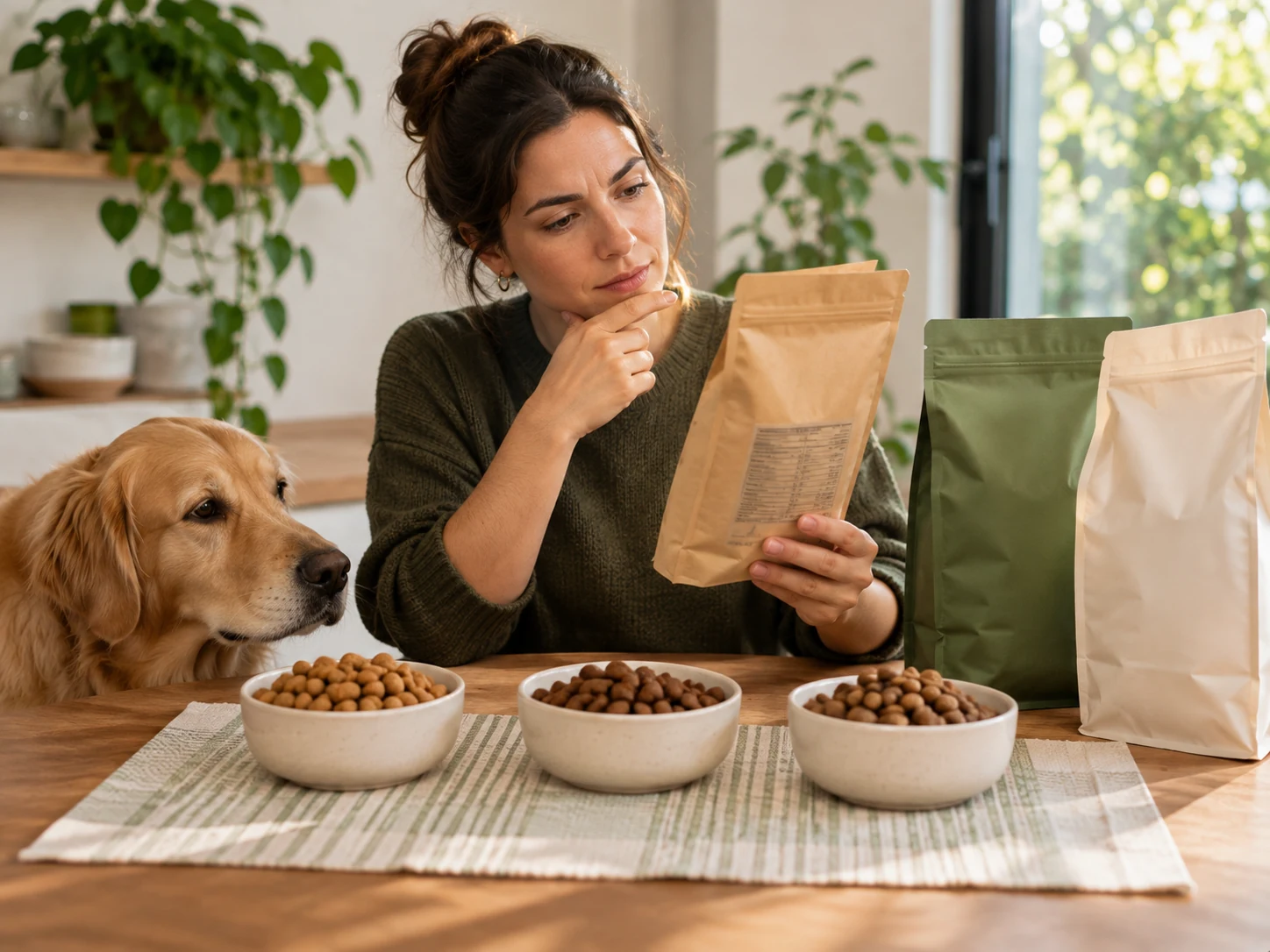
Knowing how to read a dog food label helps you separate relevant nutritional information from advertising claims. The aim is not to find the packet with the most attractive promises, but to establish whether the food suits your dog, how much to serve, and what information the manufacturer makes available. A healthy adult dog, a growing puppy and an animal with a chronic condition may have very different dietary requirements.
The label is the starting point, not an automatic guarantee of quality. Within the European Union, the marketing and labelling of animal feed are governed by Regulation (EC) No 767/2009. FEDIAF explains the main fields on pet food packaging, while WSAVA recommends looking beyond the label at the people who formulate diets, the quality controls in place and evidence of nutritional adequacy.
1. First, check whether the food is complete
Before studying the ingredient list, find a statement such as “complete pet food for adult dogs” or “complete pet food for puppies.” It means that the product has been designed to supply the nutrients needed for the stated group when fed as instructed. Complementary pet food, by contrast, is intended to be combined with other foods or offered as a treat; it should not, on its own, replace the daily diet.
Next, verify the life stage: growth, adult maintenance or reproduction. Size, body condition, activity level and medical history also affect suitability. A food with an appealing ingredient list may still be inappropriate for a large-breed puppy, an overweight adult or a dog needing a specific veterinary diet. Nutritional suitability comes before branding or individual ingredient preferences.
2. Understand what the composition tells you
The “Composition” section identifies ingredients included in the recipe, generally in descending order of their weight when added. Some manufacturers name individual ingredients; others use legally recognised categories such as “meat and animal derivatives” or “cereals.” Neither approach automatically establishes higher or lower quality.
Owners often focus on the first ingredient, but this is only one piece of information. Fresh meat contains substantial water, whereas dried animal ingredients contain less. The order in which they appear may therefore give a misleading impression of their contribution to the finished food. Nor does first position prove better nutrient availability, digestibility or overall balance.
If a product says “with chicken” and highlights a percentage, read the full ingredient declaration rather than assuming that percentage describes all animal-derived ingredients. It may refer only to the named ingredient. When the breakdown is unclear, ask the manufacturer for a precise explanation of its claims and typical composition.
3. Read analytical constituents in context
The section headed “Analytical constituents” usually declares crude protein, fat content, crude fibre and crude ash. These values help describe the food, but they do not amount to a complete nutritional assessment. Crude protein estimates protein content without revealing digestibility or whether essential amino acids are appropriately supplied. Fat provides energy and essential fatty acids, while crude fibre describes only part of the dietary fibre present.
Crude ash is the mineral residue measured after laboratory analysis. It is not ash added as an ingredient, and a single ash percentage cannot establish whether a product is good or bad. In particular situations, the amounts of calcium, phosphorus, sodium or other nutrients may matter greatly, even when they are not highlighted in the short list on the packet.
Numbers always need context. More protein is not automatically an advantage for every animal. Dogs with specific health conditions may need diets that control particular nutrients, so their food should be selected with veterinary guidance rather than a comparison of headline percentages.
4. Moisture changes the comparison between dry and wet foods
Dry kibble and wet dog food may look radically different on the label because the declared percentages include water. Wet food can contain substantially more moisture, lowering the percentage of nutrients shown in the product as sold. To compare their nutrient concentration, first calculate values on a dry-matter basis, removing the effect of moisture.
For illustration, a wet food containing 10% protein and 78% moisture contains approximately 45% protein on a dry-matter basis. Dry kibble containing 26% protein and 10% moisture contains about 29% protein on the same basis. The formula is: nutrient percentage ÷ (100 − moisture percentage) × 100. These figures are hypothetical and do not show that either product is nutritionally superior.
5. Calories and daily portions deserve close attention
Feeding recommendations are a starting estimate, not an exact prescription for every dog. Check whether the table refers to present weight or target weight and which age and activity categories it assumes. Whenever possible, locate metabolizable energy, commonly provided as kilocalories per kilogram (kcal/kg). Two foods may require different serving sizes because each gram contains a different amount of energy.
For example, a hypothetical food with 4,000 kcal/kg supplies 400 kcal in 100 g; another with 3,300 kcal/kg supplies 330 kcal in the same quantity. These are not recommended portions for your pet. They simply demonstrate why a bag's size, price and suggested daily serving cannot be compared without examining energy content.
Weigh portions, include treats in the overall daily intake and monitor body weight and body condition. Adjustments should reflect the dog's response and, where appropriate, a veterinarian's recommendations. Fresh drinking water should always be available.
6. Understand what additives are for
The word “Additives” can refer to vitamins, trace elements, antioxidants, preservatives and other authorised substances performing different functions. Their presence does not automatically suggest a poor-quality diet. Certain nutrients are added specifically to make the final formulation nutritionally appropriate for its intended life stage.
7. Evaluate the company behind the label
WSAVA recommends asking questions that rarely fit on a packet. Who formulates the diet? What training and experience does the nutrition team have? What processes check raw materials and finished products? Does the company conduct nutritional research, verify nutrient profiles and provide a typical analysis when asked? Can it explain caloric content and production arrangements?
Packaging design and descriptions such as “premium,” “natural” or “holistic” cannot replace answers to these questions. Nor does a higher price prove nutritional superiority. A manufacturer's transparency, formulation expertise and consistent quality control deserve more weight than its advertising vocabulary.
8. Check the batch, date and storage instructions
Find the responsible business, contact details, net quantity, batch number and best-before date. This information allows you to obtain product details and identify a batch if a problem arises. Follow storage instructions, particularly after opening: exposure to moisture, heat and air can affect the food's condition over time.
9. A practical five-minute label-reading routine
Use the same sequence each time you compare products. First confirm complete food status and the intended life stage. Then read composition and analytical constituents; identify moisture, calories and feeding guidance; check storage and traceability; and finally assess the producer's nutritional expertise and willingness to provide details. Compare products designed to meet similar needs.
If your dog experiences persistent appetite changes, vomiting, diarrhoea, itching, or unexplained weight changes, do not assume that switching brands is the solution. A veterinary assessment may be needed. Food selection is an ongoing process: the label informs the initial decision, while the dog's condition and response guide later reviews.
Frequently asked questions
Is more meat always better? Not necessarily. The important factors include the finished product's nutritional balance and how well nutrients are used.
Is crude ash an ingredient? No. It is a laboratory measure of mineral residue.
Can I directly compare protein percentages in a can and dry kibble? Not reliably without adjusting for moisture and considering suitability.
Should the ingredient list decide everything? No. Complete-food status, energy, life stage and manufacturer information are equally important.
Sources and further reading
- FEDIAF — Understanding Pet Food Labels
- WSAVA — Guidelines on Selecting Pet Foods
- European Commission — Feed marketing rules
- Regulation (EC) No 767/2009
Informational editorial content. It does not replace veterinary advice, especially in cases of illness, therapeutic diets or persistent symptoms.