
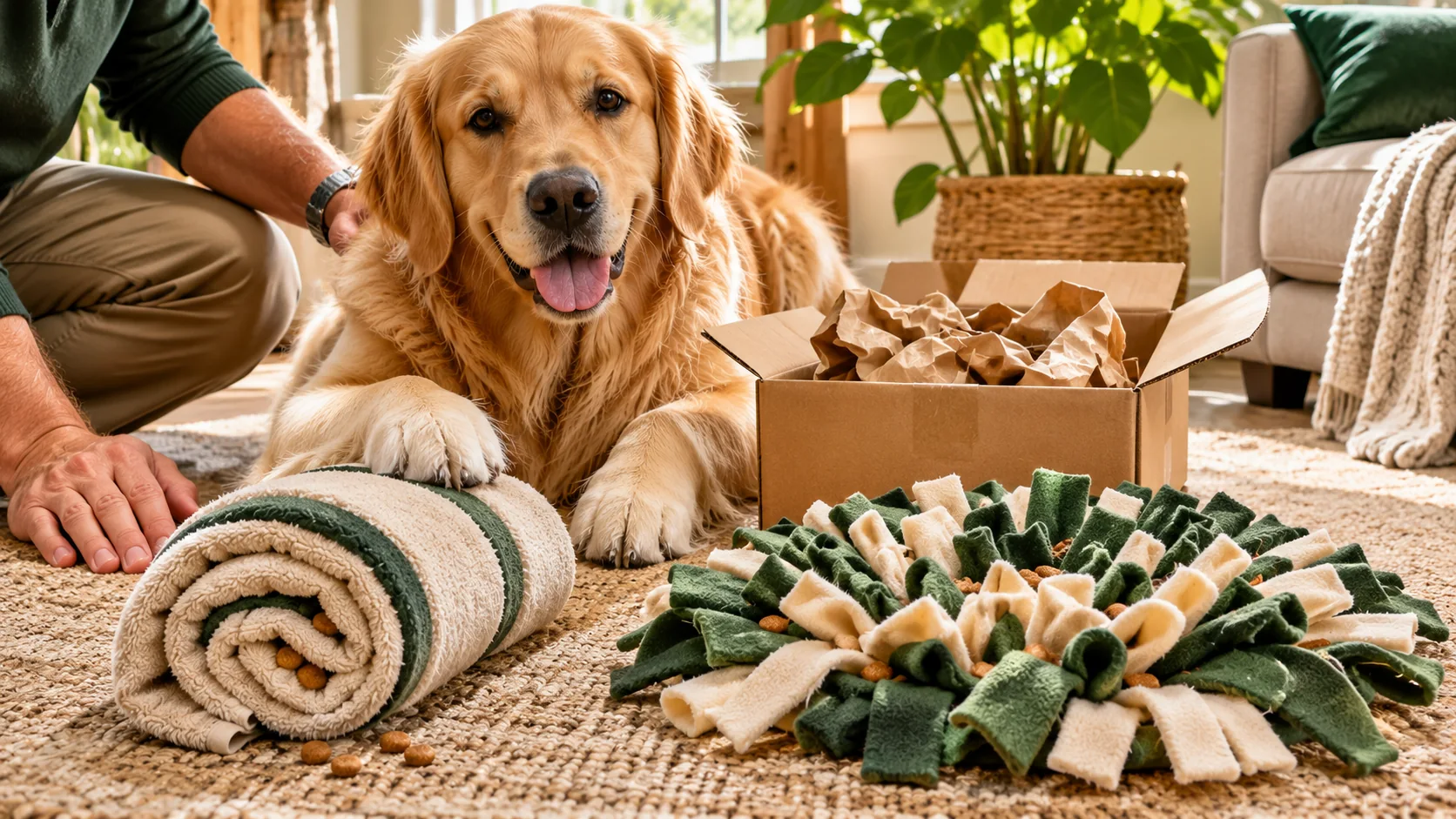
Keeping a dog engaged does not necessarily require expensive toys. An old towel, a cardboard box and clean fleece can become simple food-search games. The goal is not uncontrolled destruction but a short, safe experience matched to your dog’s individual habits. Every project below requires active adult supervision. These activities never replace walks, exercise, social contact or veterinary care.
Important: homemade enrichment requires continuous supervision. If your dog chews or swallows toy components, stop immediately.
Why enrichment matters
Sniffing, searching, exploring and choosing are natural dog behaviours. Scent-based games offer variety and opportunities for problem-solving. Dogs Trust and ASPCA recommend box games and snuffle mats as accessible options, provided the materials are suitable and supervision is constant.
Start with an easy task: a few visible pieces of kibble, a short session and a chance to walk away. Increase the difficulty only after your dog understands the game. Stop if you see frustration, chewing of the material or attempts to swallow pieces.
1. The discovery roll: treats inside an old towel
You need: a clean cotton towel without loose threads or decorations and a small portion of your dog’s normal kibble. Preparation: about two minutes.
Step 1. Lay the towel flat on the floor. Step 2. Scatter a few pieces of kibble along it. Step 3. Roll it loosely so your dog can unroll it using their nose. Step 4. Invite your dog to explore while you stay nearby.
Adjustment: begin with one fold; later try two loose folds, never tight knots. Safety: put the towel away if your dog chews or swallows fabric; do not use this toy for dogs known to ingest textiles.
2. The treasure box: a cardboard search game
You need: a plain cardboard box with all staples, tape, plastic labels and cords removed; clean scrunched paper; kibble. Preparation: three to five minutes.
Step 1. Check the box and remove any non-paper components. Step 2. Scrunch large loose paper balls. Step 3. Place them in the box and hide a little kibble between them. Step 4. Put the box on the floor and allow voluntary exploration.
Adjustment: start with visible food, then hide it more deeply. Safety: immediately remove the box if your dog starts swallowing paper or cardboard. Avoid chemically contaminated packaging.
3. The snuffle mat: reuse an old fleece blanket
You need: washed fleece without loose threads, a sturdy perforated base suitable for your dog, and scissors. Preparation: roughly 20–40 minutes depending on size.
Step 1. Cut wide fleece strips, avoiding tiny pieces. Step 2. Thread each strip through the holes and tie secure double knots. Step 3. Check all knots and remove loose strips. Step 4. Hide a few pieces of kibble in the fleece and supervise your dog as they sniff.
Adjustment: leave food close to the surface initially. Safety: only use this if your dog does not chew or swallow fleece or rubber, and store it away immediately afterwards.
Match the activity to your dog
Small dogs need materials sized appropriately for their nose; larger and highly energetic dogs may move or damage a lightweight base. Consider bite strength, destructive habits, age, dental health and tolerance for frustration. Size alone does not establish safety.
Keep puppy games particularly straightforward and short. Older dogs may benefit from searches positioned comfortably without painful bending. Seek veterinary advice for dogs with medical conditions, food allergies or mobility difficulties.
Safety checklist before each session
- Inspect materials and remove small parts, staples, tape and loose threads.
- Use dog-safe food and account for it in the daily ration.
- Let your dog choose to participate or walk away.
- Stay present and actively supervise throughout.
- Stop if there is swallowing, anxiety, frustration or intense shredding.
- Collect, wash or discard damaged materials afterwards.
If you suspect your dog has swallowed cardboard, fabric, rubber or another foreign object, contact your vet. Do not induce vomiting without professional advice.
Common mistakes to avoid
Homemade toys do not need to last a long time. A short successful search is better than a difficult activity that produces frustration. You should not increase your dog’s daily calories just because food is hidden: use part of the normal meal.
Avoid bottles with caps, brittle plastic, long cords and sharp edges. Reused does not automatically mean dog-safe. Read our dog enrichment guide and learn how dogs experience the world through their senses.
How long should each activity last?
There is no single ideal number of minutes. The right duration depends on the dog’s age, interest and experience. Begin with two or three minutes of exploration, watch for continued engagement, and finish while the activity still feels positive. Some dogs solve a puzzle immediately; others need more time to understand where the food is hidden. A food-search game should not become an endurance test.
You may offer brief sessions at different points during the day, but there is no reason to use all three toys at once. Novelty helps maintain interest: collect each game after use and bring it out on another occasion. A little scent-search activity after a walk can fit comfortably into a quiet home routine.
How can you tell whether your dog enjoys it?
Watch the whole body, not just the tail. An interested dog approaches voluntarily, sniffs, returns to the activity and takes natural pauses. If your dog walks away, stops looking or asks for help, respect that choice. Giving an animal options does not mean insisting that every hidden treat must be found.
Persistent barking, increasingly frantic movements, forceful biting of the box or hard pulling on fabric may indicate that the challenge is too difficult or unsuitable. Make the puzzle easier, remove obstacles and end the session if needed. If your dog guards food or objects, seek guidance from a qualified, reward-based behaviour professional.
Cleaning and storing homemade toys
Wash towels and fleece according to their care instructions, and allow everything to dry completely before storage. Food remnants can create odours and moisture problems, particularly if wet food is used. For these activities, regular dry kibble is often easier to clean up, provided it suits your dog.
Discard cardboard boxes when they are damp, heavily shredded or have loose pieces. Before reusing the snuffle mat, check its base and gently tug each strip to confirm the knots remain secure. Do not repair toys with staples, exposed glue or adhesive tape that could be pulled off. When unsure about safety, replace the material.
Reuse responsibly, without compromising safety
Using household materials can reduce waste, but your dog’s welfare must come first. A shirt with buttons, a detergent container or a dirty box is not safe simply because it would otherwise be recycled. Choose only clean, simple objects that are easy to inspect.
To keep costs low, reserve a small box for clean fabric intended for games and replace worn pieces promptly. If your dog has a history of swallowing objects, choose alternative scent games without loose materials, such as hiding a few pieces of kibble around a safe room while you supervise.
Sources and further reading
- Dogs Trust — Enrichment activities
- Dogs Trust — Make a snuffle mat
- ASPCA — Canine DIY enrichment
- VCA Animal Hospitals — Enrichment and supervision
Quick guide: begin with the towel, move to the cardboard box, and reserve the snuffle mat for dogs that search without destroying materials.